Global Summer School Program 2026
Duration: 6th July – 17th July, 2026
GSS26 IF GAUDÍ HAD A ROBOT
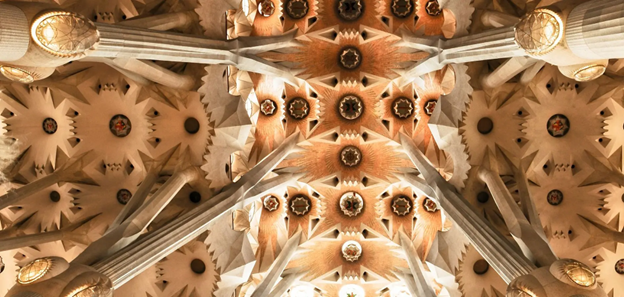
Brief
This research-driven design and fabrication workshop investigates the geometric, structural, and tectonic principles of Antoni Gaudí through the lens of contemporary computational design and multi-axis robotic manufacturing. Rather than treating geometry merely as a formal generator, this course examines how historical, analogue form-finding methods can be computationally rationalized and materially executed via automated workflows. Participants will leverage algorithmic modeling, physical material prototyping, and multi-axis robotic toolpath generation to explore the direct translation between mathematical abstraction, and robotic kinematics.
The pedagogical structure focuses on the structural and manufacturing logic of ruled surfaces, catenary systems, and quadratic geometries (hyperboloids and paraboloids). A central objective of the workshop is navigating the practical constraints of translating these complex dual-curvature forms from digital environments into physical architecture. By progressing from manual material manipulation to 6-axis robotic subtractive milling, participants will critically evaluate the interplay between geometric rigor, and the operational limits of robotic automation in contemporary construction.
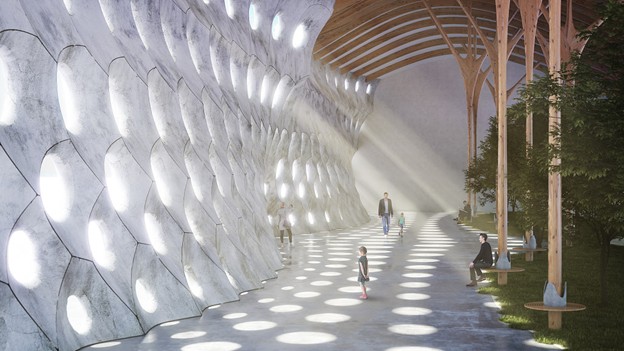
Credits: After Gaudi Seminar, Master in Advanced Architecture 01
Learning Objectives:
Participants will:
- Analyze Geometric and Structural Logic: Evaluate how Gaudí deployed ruled surfaces, quadratic geometries, and catenary curves as both formal and structural generators.
- Integrate Analogue and Digital Workflows: Translate complex geometric principles into physical architectural artifacts by linking historical form-finding with digital parametric modeling.
- Evaluate Material and Machining Constraints: Analyze the physical properties of fabrication substrates, directly correlating tool-material friction, structural capabilities, and tolerances with manufacturing parameters.
- Develop Robotic Fabrication Toolpaths: Author and simulate multi-axis toolpaths for 6-axis industrial manipulators, adapting digital models to accommodate hardware realities such as kinematic reach envelopes, joint singularities, and subtractive milling constraints.
Workshop Content
The workshop is structured into two distinct, progressive phases that bridge historical spatial theory with advanced subtractive manufacturing.
- Phase 1 (Week 1): Focuses on the theoretical frameworks of Gaudí’s geometry, explored through hands-on clay massing exercises. Students perform scaled physical tests to understand structural and geometric behavior, concluding with the translation of these physical concepts into clean digital models. At the same time they will look into how these techniques can be transferred to the digital and prepare designs for the second phase of fabrication.
- Phase 2 (Week 2): Focuses on advanced digital fabrication, transferring computational designs into reality using 6-axis robotic milling and 3-axis CNC routing. Production will concentrate on two main architectural features: catenary arch systems and ornamented openings driven by ruled surface subtraction.
Week 1
Thematic and theoretic Framework (Week 1)
Ruled Geometry
The workshop begins with an investigation into ruled geometries—surfaces generated through the movement of straight lines. Participants will study examples found in Gaudí’s work,
Through geometric construction and model-making exercises, participants will explore how complex spatial forms can emerge from simple generative rules.
Catenary Logic and Structural Form
A central focus of the workshop will be the catenary curve and its transformation into compression-based architectural systems. Participants will examine Gaudí’s hanging-chain models and inverted structural methodologies as precedents for form-finding.
Neo-Gothic and Catalan Modernisme Aesthetics
The workshop examines how Gaudí transformed Neo-Gothic principles through mathematical geometry, structural form-finding, and nature-inspired spatial systems, leading to a new architectural language based on ruled surfaces, catenary structures, and branching geometries.
Manual Clay Fabrication methodologies (1st week)
To continue the theoretic research, participants will explore the newly learned techniques through handson exercises. Throughout the week they will explore these techniques through scaled clay models:
-
Wire-Cutting Studies
-
Mould-Making and stencils
-
Bifurcation and Branching Systems
Week 2
Digital Fabrication 6axis Robotic fabrication and CNC milling
Participants will develop fabrication-ready models for subtractive manufacturing processes.
Investigations include:
- Toolpath generation
- Surface rationalization
- Milling strategies for ruled and doubly-curved geometries
- Assembly and material optimization
- Stereotomy for modular discretization
Workshop Outputs
Participants will produce:
- Geometric analysis drawings
- Physical study models
- Material and fabrication prototypes
- Experimental moulds and casts
- CNC-milled artifacts
- Robotically milled catenary blocks and assembly
- A final architectural installation or prototype synthesizing geometric, structural, and fabrication research
Workshop Outcome
The workshop establishes a direct relationship between mathematical principles, material processes, and contemporary architectural form. By analyzing Antoni Gaudí’s synthesis of geometry, structure, and craft, participants will develop hands-on digital, CNC, and robotically fabricated design elements that integrate into a shared architectural template.
The goal is to start from the basic principle through scaled massings in clay and progressively increase the sophistication of the methodology and technology.
The final exhibition replicates the environment of Gaudí’s original historical workshop, displaying individual and group explorations through a combination of scale models and 1-to-1 material prototypes.
Hardware / Software requirements
Main & secondary software
Rhinoceros 7.0. The 90-day trial version can be downloaded from the website www.rhino3d.com/eval.html – Rhino needs to be able to access internet, so crack Versions won’t work for this workshop.
Adobe Creative Cloud (Illustrator, Photoshop, InDesign, Premiere Pro, After Effects): Subscription to all Creative Cloud applications with the student discount could be done here.
Other software to be specified by session.
*Because Grasshopper 3D works best for the Windows operating system, we recommend students to have an installation of Windows (preferable Windows 10 x64). If you have an Apple computer, it is recommended that you install Windows on Boot Camp/ Parallels or VMWare. It is recommended that you max out the RAM potential on your computer.
Hardware
8 GB memory (RAM) or more
At least 600 MB space in the hard drive
Operational System
Windows 11 or 10 (Grasshopper 3D is only currently available for the Windows operating system. For this reason, every student is required to have an installation of Windows).
Note: If you have an Apple computer, it is recommended that you install Windows on Boot Camp which will perform better than Parallels or VMWare.
Study References
List of useful tutorial videos: Global Summer School 2026
Grasshopper tutorials: https://github.com/nachomonereo/grasshopper-free-course
Previous Knowledge / Eligibility
The workshop is open to all applicants with a bachelor degree (or in progress) in any field related to Architecture, Design, Arts and Engineering and understanding of any parametric tools. The participants do not need any prior coding or parametric design knowledge. Getting familiar with Rhinoceros (Rhino) software ahead of the workshop will make progress easier.
Faculty Team
Pit Siebenaler – Robotic Fabrication Expert, Robotics Lab
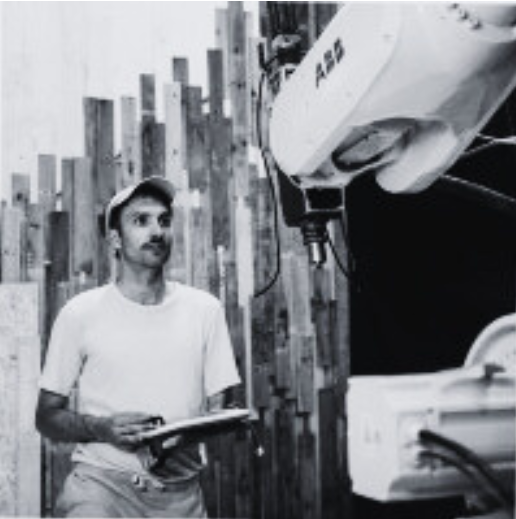
Pit Siebenaler is an Architect with a degree from La Cambre Horta in Brussels and a Master’s in Robotics and Advanced Construction from IAAC. At IAAC, Pit specializes in integrating sensing workflows with robotic manufacturing to repurpose waste wood, promoting sustainable building practices. Currently, Pit serves as a research assistant at IAAC, supporting the Master’s program in Robotics and Advanced Construction.
Akshay Madapura – Computational modeling expert, Advanced Architecture Lab

Akshay Madapura is a Computational Design Specialist and Architect from India, with a strong foundation in advanced digital technologies and their application in architecture. He is a graduate of the Master in Advanced Architecture at IAAC, where he has played a key role in numerous projects and seminars that explore the integration of digital tools with physical design processes.
His areas of expertise include algorithmic design, machine learning, computer vision, interaction design, and robotic fabrication. Akshay’s primary focus is on applying data-driven algorithms to real-world architectural challenges, aiming to create innovative, efficient, and sustainable design solutions. With a passion for advancing computational methodologies, Akshay is committed to driving the evolution of architecture through the informed use of technology, pushing the limits of how data and algorithms can shape the future of design
Experts & Guest Lecturers
Mark Burry – Chief Architect of Sagrada Familia (1979-2016), IAAC After Gaudi Seminar Lead

Prof Mark Burry AO FRAIA FTSE is a registered architect and the Founding Director for Swinburne University of Technology’s Smart Cities Research Institute (SCRI). His role is to lead the development of a whole-of-university research approach to ‘urban futures’, helping ensure that our future cities anticipate and meet the needs of all – smart citizens participating in the development of smart cities.
He is a practising architect who has published internationally on two main themes: putting theory into practice with regard to procuring ‘challenging’ architecture, and the life, work and theories of the architect Antoni Gaudí. He has been Senior Architect to the Sagrada Família Basilica Foundation since 1979, pioneering distant collaboration with his colleagues based on-site in Barcelona concluding in late 2016.
Recent publications include an edited 4-volume 1,600-page collection of papers setting out the grounds for Digital Architecture as a critical concept, including a 9,000-word introduction to the set with accompanying introductions to each volume (Routledge – Taylor & Francis, March 2020), and an edition of AD titled ‘Urban Futures – Designing the Digitalised City’ (Wiley, May-June, 2020).
Rodrigo Aguirre – Computational Design Expert, IAAC After Gaudi Seminar Lead
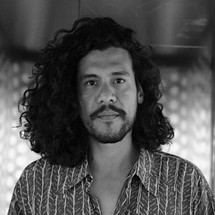
Rodrigo Aguirre is a Nicaraguan architect based in Barcelona since 2011, with a background in architecture from UAM Nicaragua and a master’s degree in advanced architecture from IAAC. His work focuses on algorithmic design and design engineering, especially in digital fabrication, robotic fabrication, and 3D printing.
With more than eight years of experience in parametric design and teaching, he has led workshops in several countries and has contributed to both academic and professional practice. He currently works as a senior computational design specialist at MYAA, while continuing to explore the relationship between design, computation, material, form, and space.
Alexandre Dubor – IAAC Robotics Lab Director

Alexandre Dubor is an architect and researcher combining new technologies in an attempt to improve how we build and live in our cities. He holds a Master degree of Architecture & Engineering from EAVT & ENPC (France) and a Master Degree in Advanced Architecture from IAAC (Spain), with a specialization in robotic fabrication and large-scale additive manufacturing (FabBot 3.0).
He holds as well a French architectural licence (HMONP) and has worked in various architectural offices from competition stage to delivery (Libeskind, Atenastudio, iDonati, AREP) while exploring the potential of scripting and coding in a separate practice (Collectif277). Since 2012, he is working at IAAC as an expert in digital and robotic fabrication. He is now leading the Open Thesis Fabrication programme as well as the Master in Robotic and Advanced Construction at IAAC.
Together with IAAC staff, students and industrial partners, he is investigating how new advances in material, digital fabrication and computational design could lead to a better construction ecosystem, towards a more efficient, affordable, sustainable and personalised built environment.
Location
Participants will assist to classes, learn and prototype at the Institute for Advanced Architecture of Catalonia (IAAC), located at C/Pujades, 102, Poblenou 08005, Bracelona, in the recently created district known as 22@, a focus for companies and institutions oriented toward the knowledge society. The neighbourhood is close to the historic centre, the seafront, the Plaça de les Glòries and the Sagrera APT station, making it one of the most dynamics enclaves in the city.
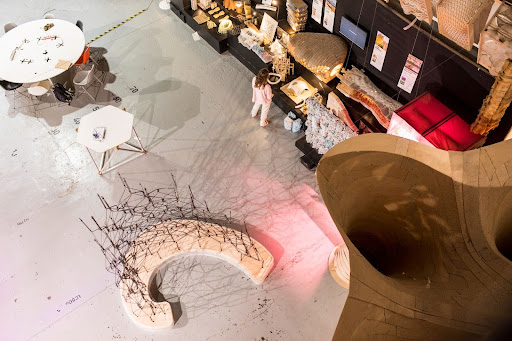
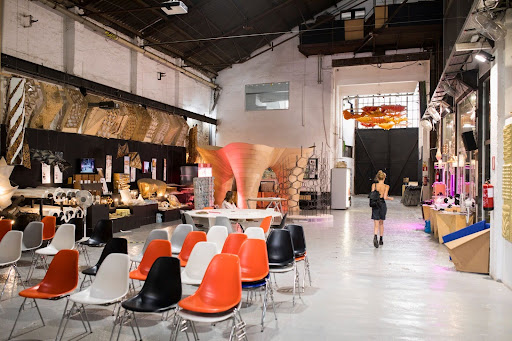
IAAC Main Hall, Pujades 102, Barcelona (Spain).
Workshop Fee
The GSS26 On-Site Workshop fee is €1,000 with the early bird offer available until 8th June 2026. After this date, the standard fee of €1,200 will apply until the final application deadline on 30 June 2026. The fee includes all course materials, and no additional registration fee is required. Please note that flight tickets, accommodation, and meals are not included.
Participants are required to bring their own computer with the necessary software installed. Further details about the software will be provided closer to the start of the workshop.
*IAAC will reserve the right to cancel the on site workshop in case the minimum number of students for the workshop won’t be reached. The GSS coordination ([email protected]) will inform you if this possibility could happen and IAAC will refund the entire fee to the participant.
Accommodation in Barcelona will not be included. IAAC will advise participants on accommodation, if required.
Transportations between IAAC facilities is in charge of IAAC. Upon arrival, participants will be equipped with the IAAC students access card and IAAC welcome kit.
Workshop Schedule
Week 1

Week 2